











How Hedger AI works and what Core Charging commits you to
HedgerX describes Hedger AI as a trading agent that learns from top traders. This page covers how it decides, what you pay in, what HedgerX says about payouts and where its documents stop short.
Conditions HedgerX states
- Entry starts at 15 USDT, in multiples of 15.
- Benefits stop at five times the amount charged.
- Benefits are paid half in USDT and half in HEX.
- Moving benefits to HedgerX needs a transfer quota earned by trading futures.
Not yet publicly confirmed
- The calculation base of the Contract Loss benefit, which the documents do not define.
Hedger AI is two things: an agent and an entry program
The agent is the trading system: it studies traders, reads the market and places orders on HedgerX. Core Charging is how users join. They pay USDT or HEX and receive "ecosystem rights" with daily benefits.
HedgerX's deck calls these two business lines that must be kept apart, and says users neither withdraw nor direct the trading funds.
HedgerX's documents treat Hedger Pay as a different program.
What the agent looks at and what it decides
Human Alpha
On-chain orders of top traders, how they hold, add and reduce positions, their public views and the market scenarios where they did well.
Market and quant data
Price, funding rates, open interest, order book, volatility, on-chain capital flows and event signals.
Risk data
Account status, liquidity, asset correlation, drawdown and portfolio limits.
The agent decides whether to trade, the direction, the position size, the leverage, and the take-profit and stop-loss levels. The result can be no trade, wait, an independent trade, or an adapted version of a trader's order.
| Who | Direction | Size | Leverage | Stop loss | Take profit | HedgerX label |
|---|---|---|---|---|---|---|
| Trader A | BTC long | 10% | 10x | -3% | +10% | Learning source |
| Core plan A | No trade | Environment mismatch | ||||
| Core plan B | BTC long | 5% | 5x | -2% | +8% | Direction approved, risk restructured |
| Core plan C | Wait | Awaiting multi-source confirmation |
HedgerX's illustration of decision logic. It is not a fixed strategy and not a guaranteed return.
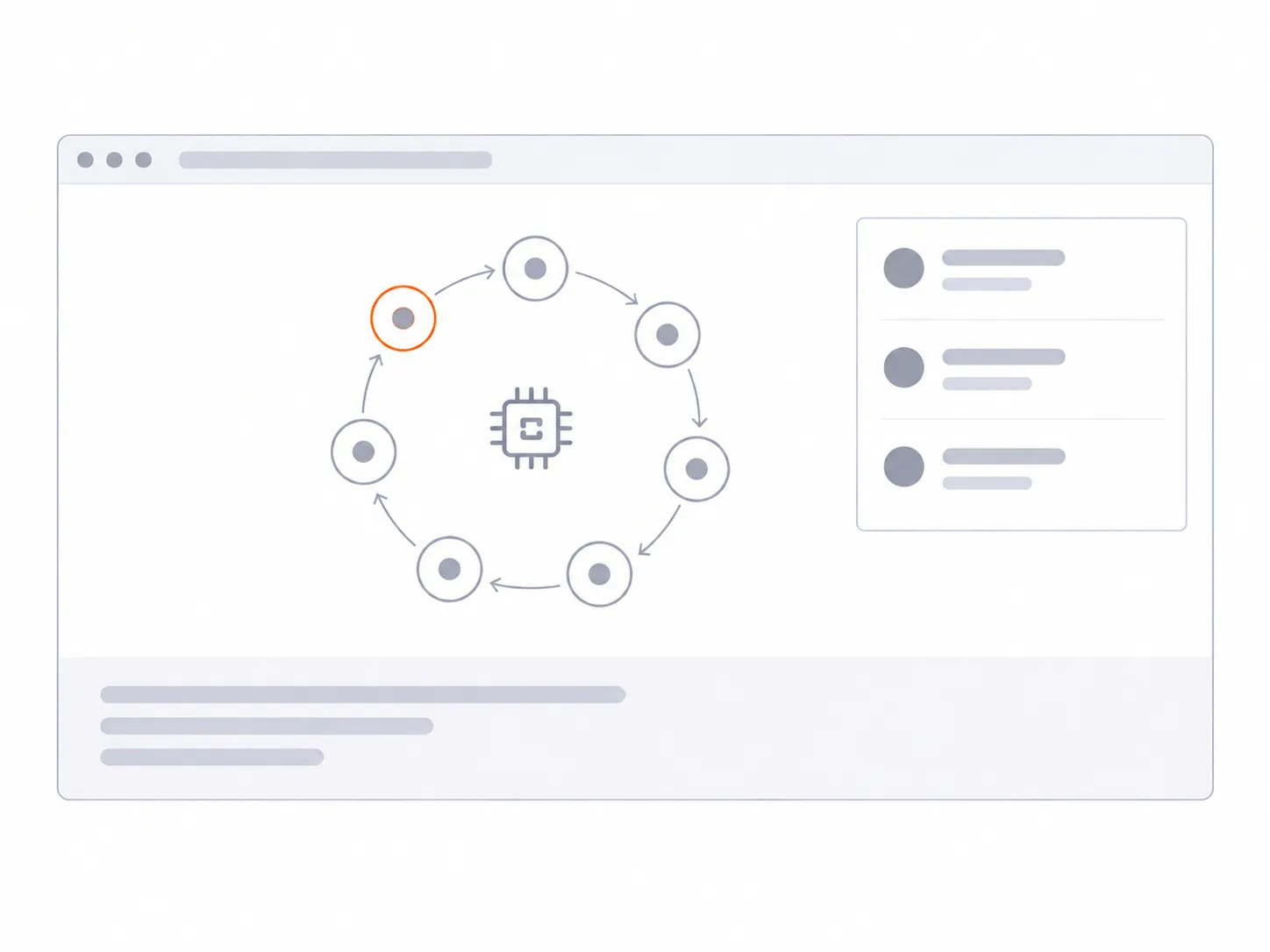
The seven steps of the learning loop
- Observe Trader behaviour and market conditions.
- Distill Extract edges and trading styles.
- Reason Assess whether they apply now.
- Adapt Rebuild the trading parameters.
- Execute Place orders within risk limits.
- Learn Record outcomes and deviations.
- Evolve Update weights and strategies.
Human Alpha and the six seats
HedgerX says the agent does not copy orders. It studies how a trader decides: where they perform, which behaviours go with profit, and when they tend to be wrong, for example with excessive leverage, against the trend or in thin liquidity. The agent then filters the trade, cuts leverage or size, or adjusts take-profit and stop-loss.
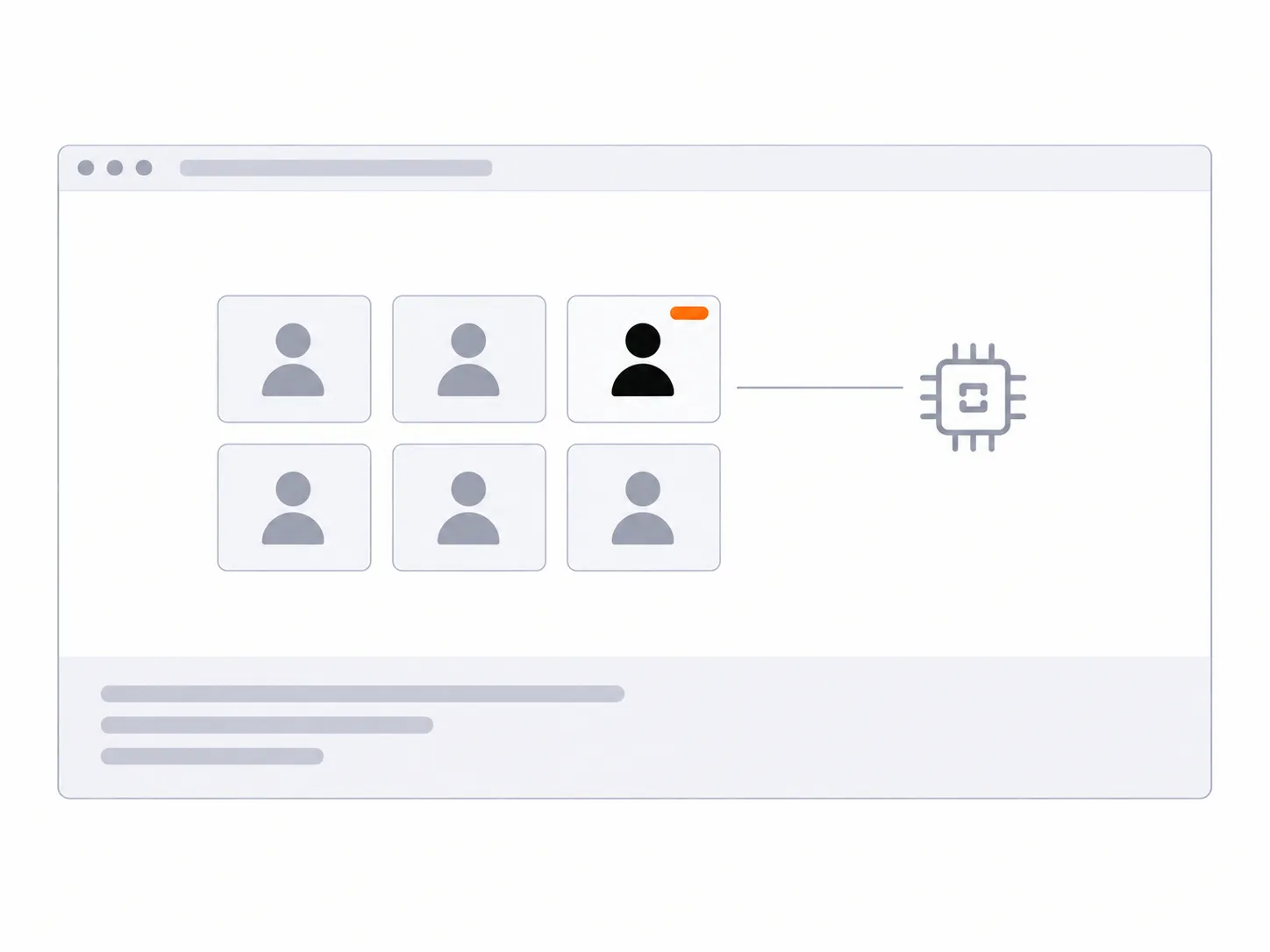
The six seats are six separate sources, each a distilled trading style. The core assigns weights dynamically instead of voting, and every seat goes through distillation, validation on historical samples and allocation.
The deck does not name the traders behind the seats.
Hedger AI against copy trading and AI quant trading
| Copy trading | AI quant trading | Hedger AI | |
|---|---|---|---|
| Main learning source | A single trader's orders | Price, factors and historical data | Human Alpha plus market, quant and risk data |
| Who decides | The trader | Model rules | The AI core's own judgement |
| Copies 100%? | Usually centred on replication | Not applicable | Explicitly not 100% copied |
| Trade parameters | Proportional or preset by the user | Preset by the strategy | Position, leverage and take-profit/stop-loss adjusted dynamically |
| Learning loop | Post-trade statistics | Backtesting and retraining | Observe, execute, result, weight evolution |
| Core asset | Trader traffic | Models and data | A verifiable Human Alpha network plus the AI core |
This is HedgerX's own comparison.
What HedgerX promises to show
Promised in the deck
- Observation evidence
- Public on-chain orders, market data and opinion sources are traceable.
- Decision evidence
- Why a trade was followed or skipped, and how parameters changed.
- Execution evidence
- Timestamps, order parameters, transactions and risk-control actions.
- Result evidence
- Profits, losses, drawdowns and model errors, beyond the win rate.
What the Hedger AI app shows: screens from 21 October 2026
On 21 October 2026 we captured the Hedger AI section of the HedgerX app: the main screen, the hit-rate page and the built-in guide, plus the daily reports for the seven days before. Everything below is HedgerX's own figures as the app displayed them. They have not been independently audited yet.
Figures the app displayed
- Data read
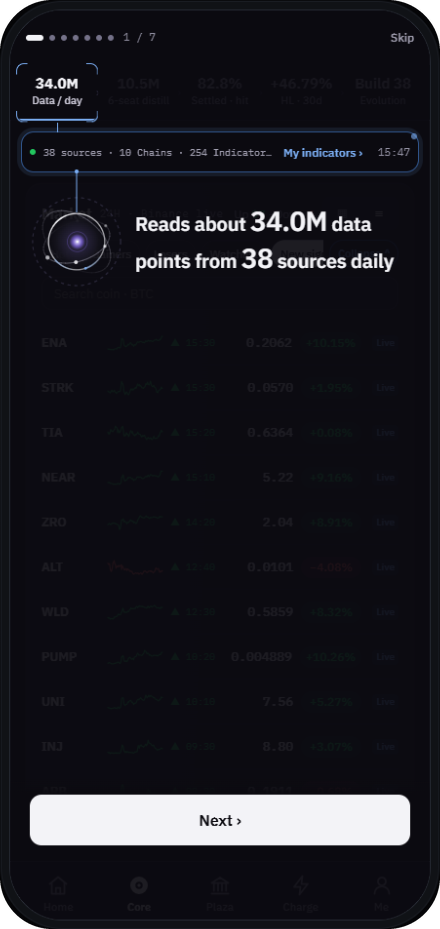
- About 34.0 million data points a day from 38 sources, 10 chains and 254 indicators.
- On-chain fills
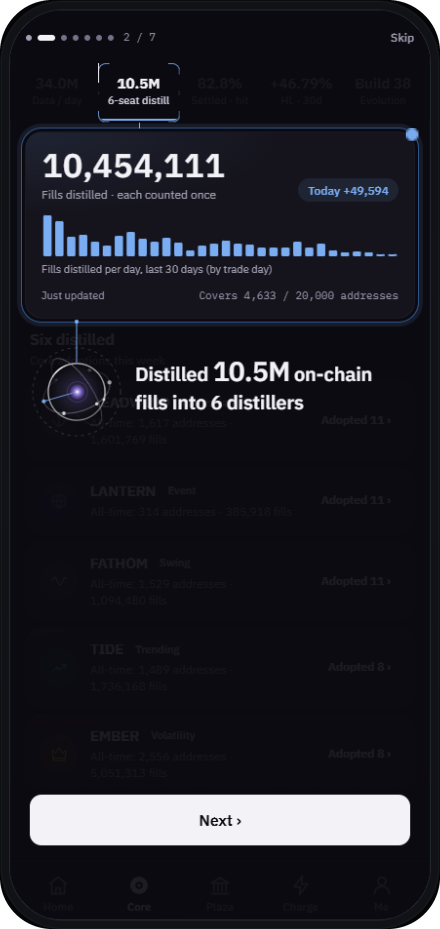
- 10,454,111 fills grouped into six "distillers". The app says it covers 4,633 of 20,000 addresses.
- Hit rate
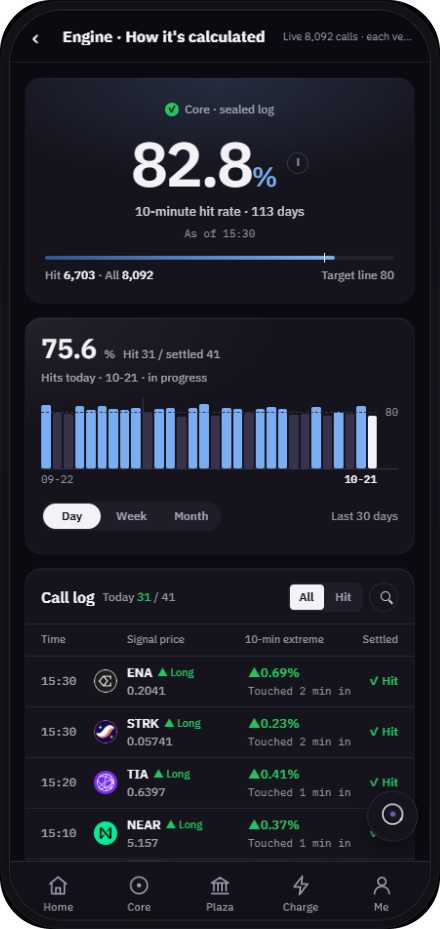
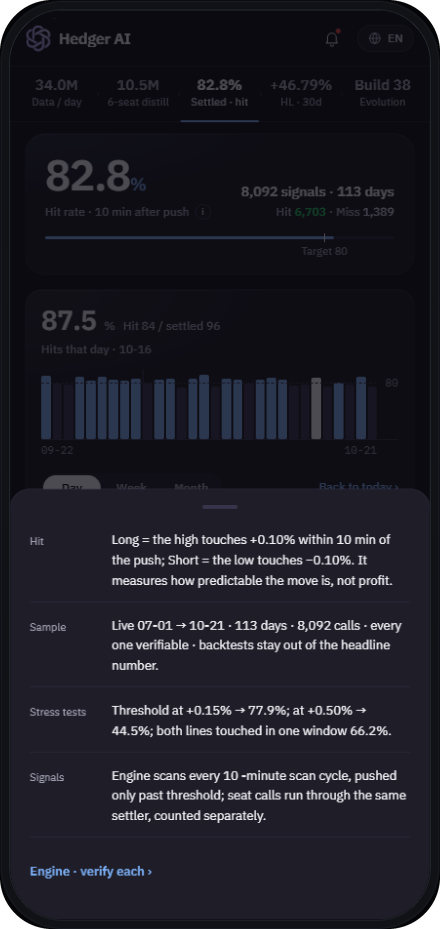
- 82.8% over 113 days (1 July to 21 October): 6,703 hits out of 8,092 signals, against a target line of 80%.
- Hyperliquid, last 30 days
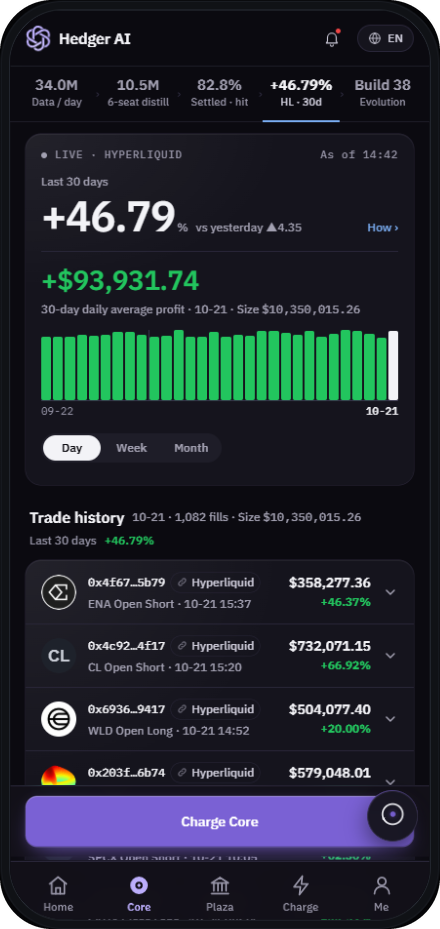
- +46.79% at 14:42 on 21 October. The app labels it live on Hyperliquid and says every close can be verified on-chain.
- Evolution
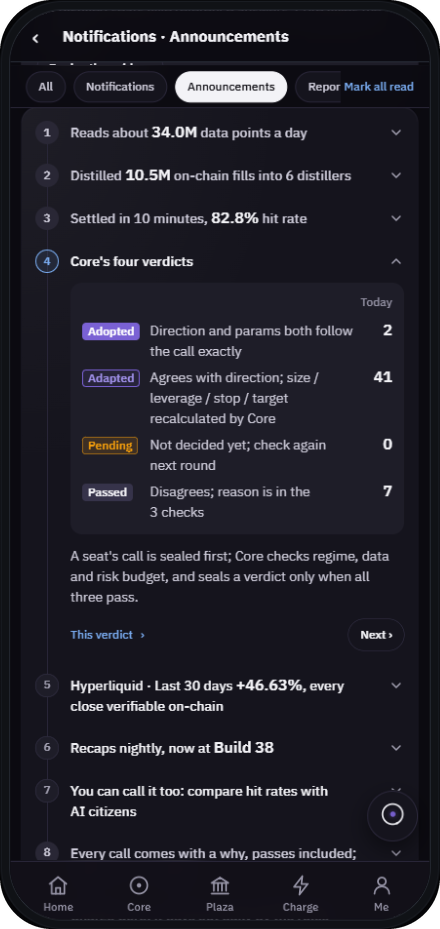
- Build 38 since 14 September. On the day it logged 50 verdicts: 2 adopted, 41 adapted and 7 passed.
How to read these numbers
- A hit is not a profit.
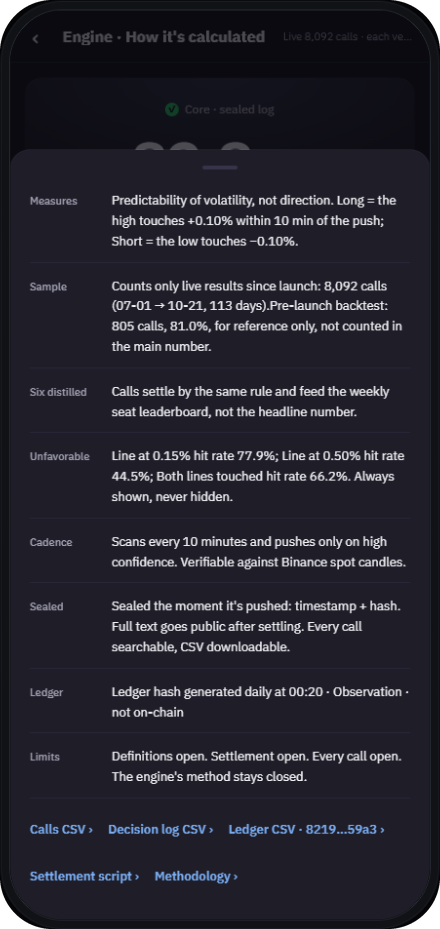
- The app counts a hit when the price touches 0.10% in the signal direction within 10 minutes. It says the figure measures the predictability of volatility, not direction or profit.
- The 30-day figure is not your payout.
- The app asks "Is the 30-day figure my earnings?" and answers no. It is the 30-day total on the trade details page, and what a user receives is the daily payout under the Core Charging rules.
- The line matters.
- The app lists its own stress tests: 77.9% with a 0.15% line, 44.5% with 0.50%, and 66.2% when both lines must be touched.
- Live sample versus backtest.
- The headline number counts only live results since launch. A pre-launch backtest of 805 calls at 81.0% is shown for reference and left out.
- The records.
- Each call is sealed with a timestamp and a hash when it is pushed, and the app offers CSV downloads of calls, decisions and the ledger. The ledger hash is generated daily at 00:20, and the app says it is an observation, not an on-chain record. The engine's method stays closed.
- Checks you can run.
- Every trade in the history is listed with a shortened Hyperliquid wallet address and a Hyperliquid link, so each one can be looked up on Hyperliquid. The app also says hit results can be compared with Binance spot candles.
Seven days of daily figures
The hit rate for each day and the 30-day Hyperliquid figure at the end of it, from the app's daily reports.
| Date (October 2026) | Hit rate that day | Hits / settled | Hyperliquid, 30 days |
|---|---|---|---|
| 15 | 77.2% | 105 / 136 | +42.95% |
| 16 | 87.5% | 84 / 96 | +45.42% |
| 17 | 75.0% | 48 / 64 | +47.60% |
| 18 | 80.0% | 44 / 55 | +47.21% |
| 19 | 78.5% | 51 / 65 | +44.95% |
| 20 | 89.2% | 74 / 83 | +42.44% |
| 21 | 75.6% | 31 / 41 | +46.79% |
The 21st was still in progress when captured, so its figures are a snapshot.
The screens
-
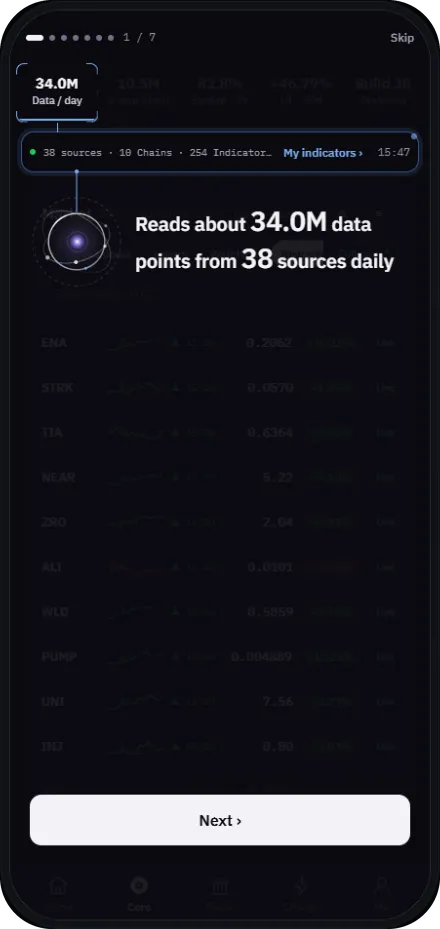
Guide step 1: the app says it reads about 34.0 million data points a day from 38 sources. -
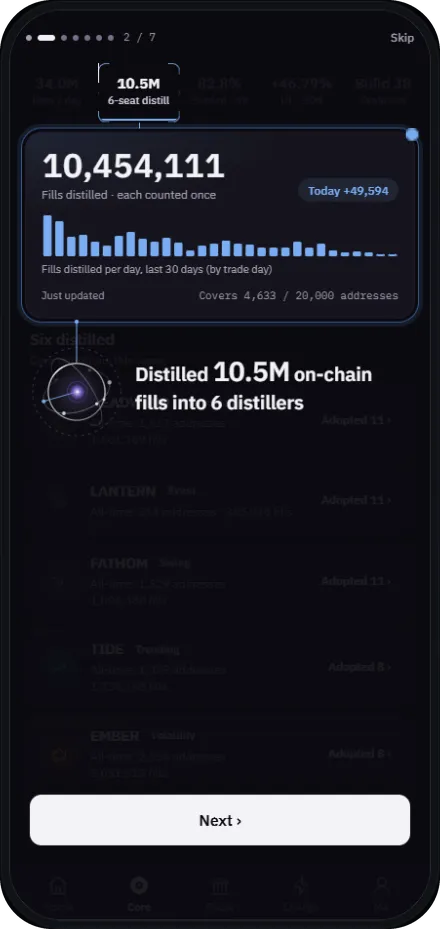
Guide step 2: 10.5 million on-chain fills grouped into six distillers. -
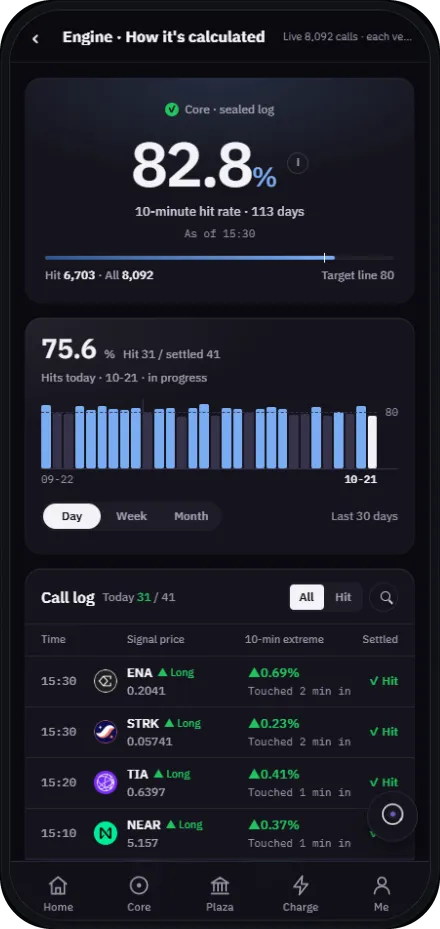
Hit-rate page: 82.8% over 113 days, 31 of 41 settled calls today, and the call log. -
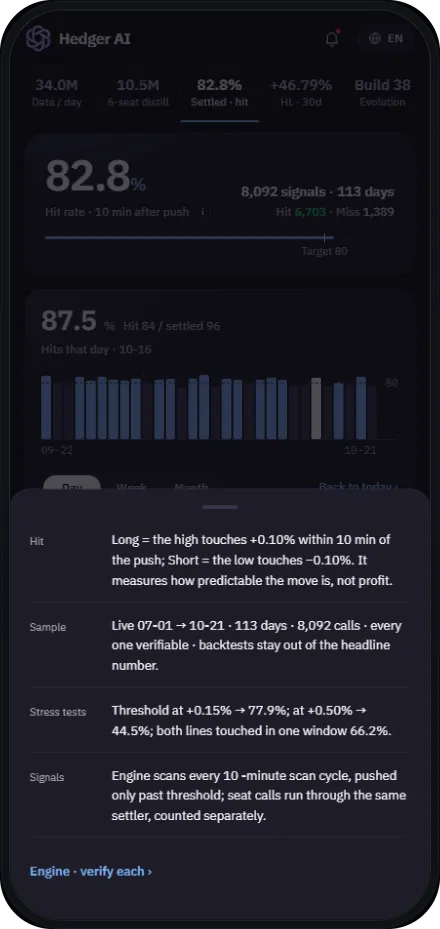
How a hit is defined, the live sample, the stress tests and the signal cadence. -
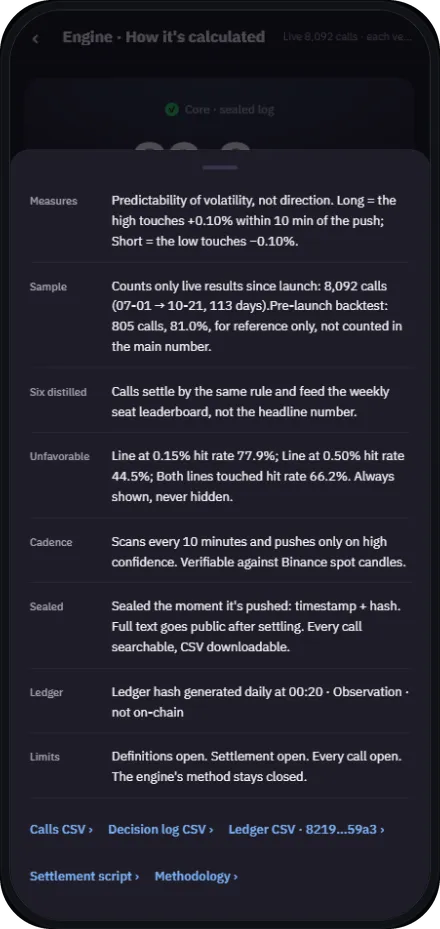
The limits the app states: backtest excluded, ledger not on-chain, method closed, CSV downloads. -
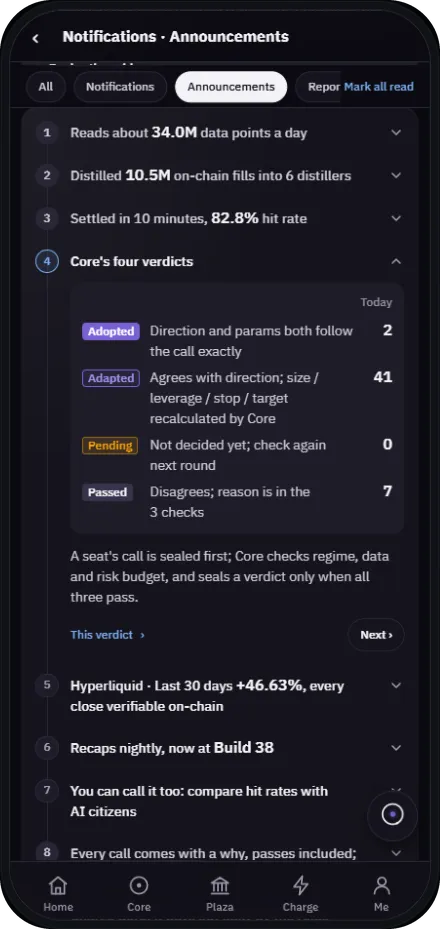
Core's four verdicts, adopted, adapted, pending and passed, with the day's counts. -
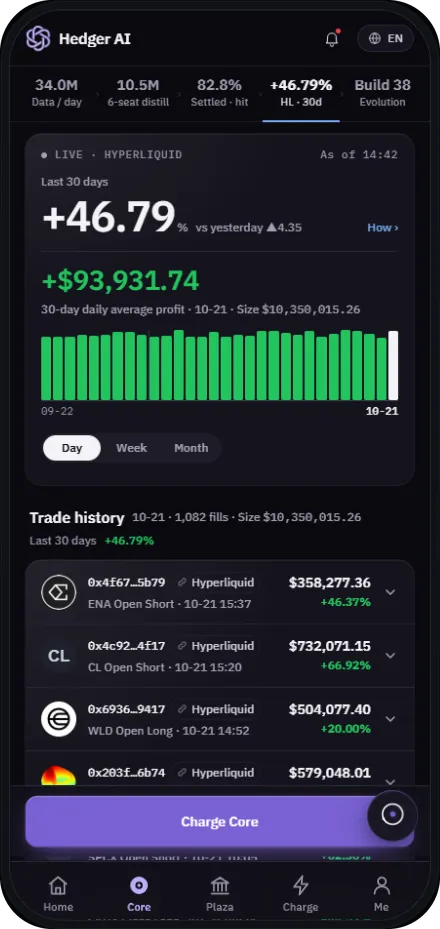
Hyperliquid view on 21 October: the 30-day figure and the trade history. -
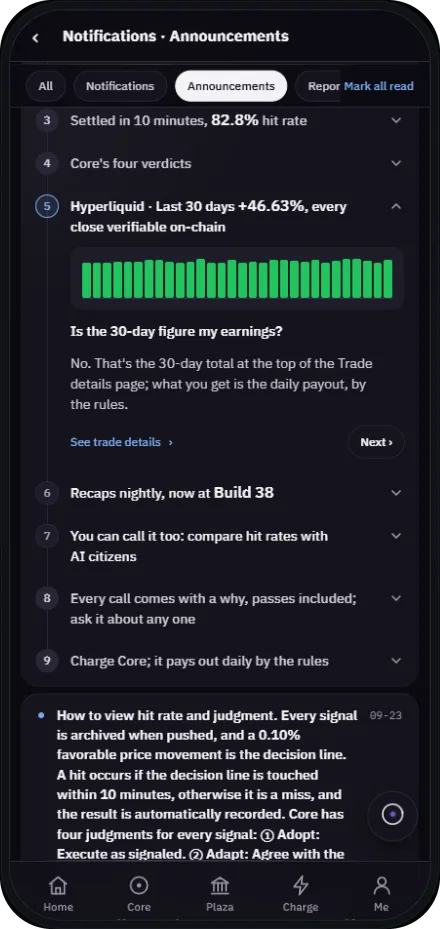
The app's own answer: the 30-day figure is not a user's earnings. -
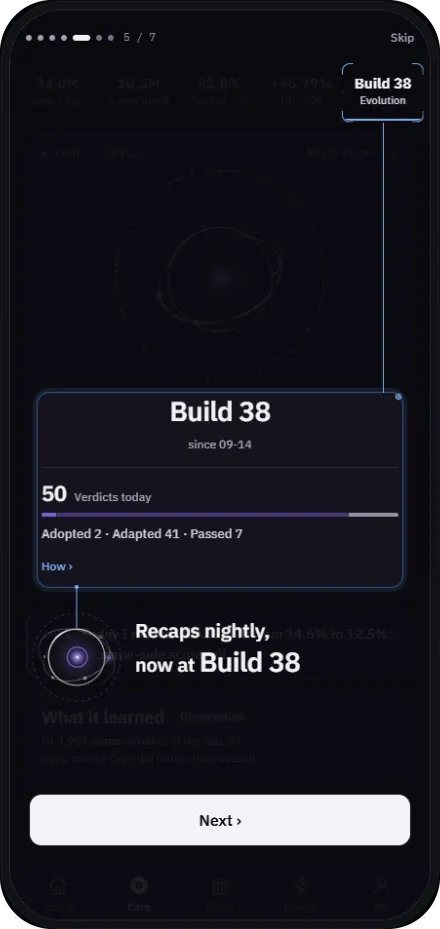
Build 38: the nightly recap and the verdict counts. -
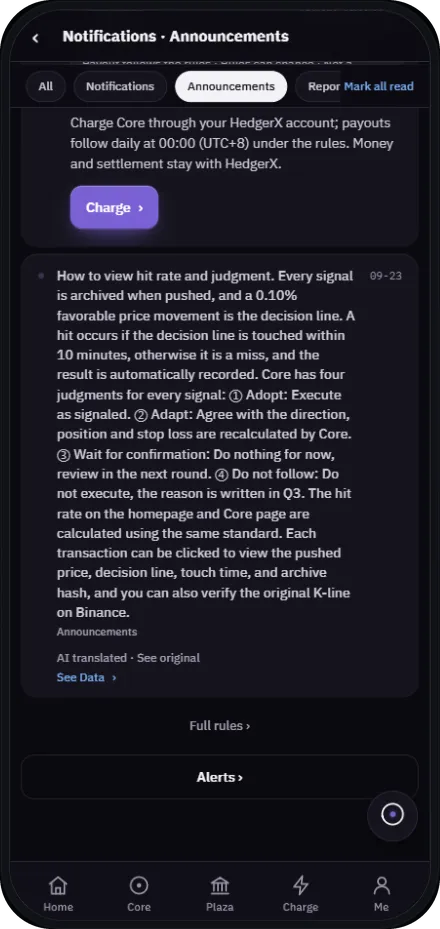
The funding and risk rules the app shows before entry.
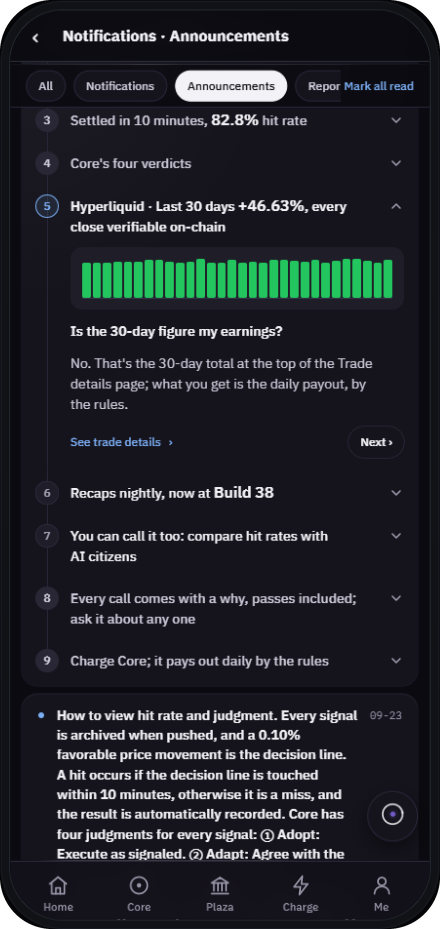
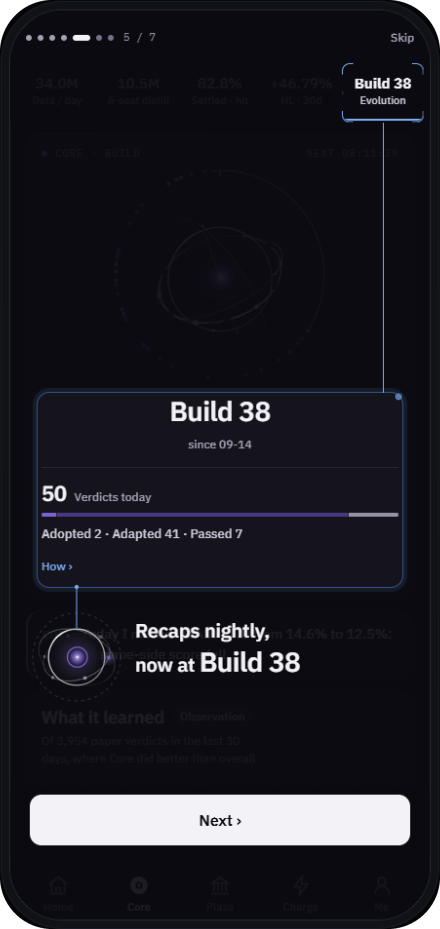
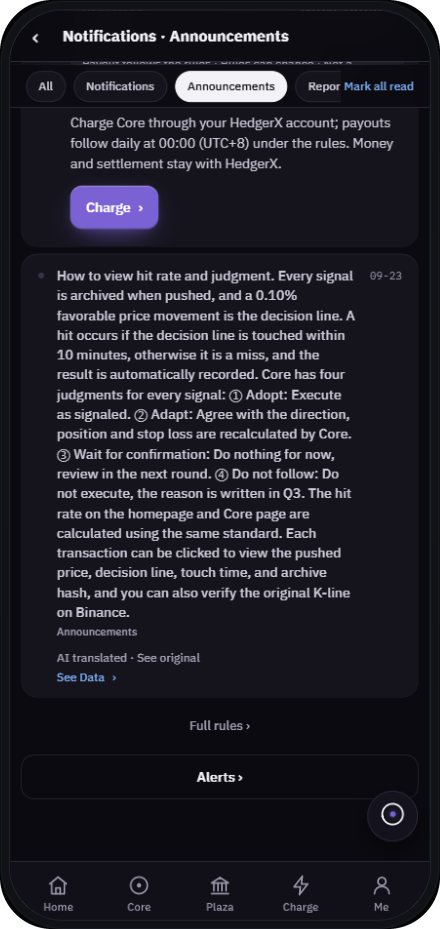
Captured from the app on 21 October 2026, with daily reports for 15 to 21 October, and cropped to the phone. Figures change every day. This is not financial advice and not a promise of results.
Core Charging: how users join and what HedgerX states
- Open the product. In the HedgerX app or web, go to Hedger AI and read the Core Charging, benefit and risk information.
- Choose asset and amount. USDT or HEX. Each charge is a multiple of 15 USDT, with a 15 USDT minimum. HEX used for charging is burned.
- Get benefit eligibility. The cumulative amount sets the basic daily rate tier, the Core generation and the personal requirement within the team ranks. Only users who have charged receive daily benefits.
- See benefits and transfer conditions. Moving benefits to HedgerX needs a transfer quota. Charging can be repeated with no upper limit.
Users do not withdraw or direct the trading funds.
The deck sets a basic daily rate that rises with the cumulative amount charged, from 0.4% to 0.7%. Four Core generations (Gemini, Astra, Fable, Mythos) add up to 0.1 percentage points, for a top rate of 0.8% a day. Benefits are paid at 00:00 UTC+8, half in USDT and half in HEX.
Benefits stop at five times the cumulative amount charged. The cap counts the basic benefit, the generation bonus, and the direct-referral, level-differential and same-level benefits.
The deck says service revenue and trading capabilities should not be treated as guaranteed fixed income.
What those rates add up to
At 0.7% a day, 30 days of benefits equal 21% of the amount charged. At 0.8% they equal 24%. At 0.7% a day, the five-times cap is reached after about 714 days of benefits.
These are our sums from HedgerX's stated rates. They are simple sums without compounding and are not a forecast. Half of each payout is HEX, so its value moves with the HEX price.
Where HedgerX says the money comes from
- Core Charging
- Creates product cash flow for data, computing power and risk systems.
- HedgerX trading business
- Earns fees on spot and derivatives trading.
- Real trading by the agent
- Produces results and learning data, including profits, losses and drawdowns.
- AI services
- An API, strategy services and B2B licensing are a long-term direction.
"In the short term, explicit cash flow sources are required; in the long term, relying solely on rights sales is unsustainable."
HedgerX Hedger AI narrative deck, business flywheel slide
Where HedgerX says Hedger AI is heading
The updated Business Model Deck (October 2026) describes three stages. They are plans, not delivered products.
- Stage 1: AI Core productization
- Build an autonomous decision loop that users can understand and the platform can verify, recording learning sources, judgments, orders and outcomes.
- Stage 2: multi-seat, multi-strategy network
- Add Human Alpha sources and strategy combinations, with dynamic weighting and learning across markets and cycles, so no single source of experience dominates.
- Stage 3: AI Financial Network
- Use HedgerX's execution, settlement and value-distribution infrastructure to connect more agents and ecosystem services.
Getting benefits out: the transfer quota
Moving benefits to a HedgerX account needs a transfer quota. There are two ways to get it.
- Futures trading
- Opening or adding to a derivatives position gives quota equal to 20 times the funds used to open it. Leverage does not change the amount. The quota is valid for the same day and resets at 00:00 UTC+8.
- HEX
- Quota equals the HEX amount times its real-time price times 20. It does not expire, and there is no daily limit.
So taking benefits out means trading futures or buying HEX. HedgerX's own tutorial warns that leverage above 10x is easily liquidated.
Ranks and team payouts
Hedger AI has 14 ranks, A0 to A13, with requirements for personal charging, direct referrals and team performance. From A2 the latest deck adds a second team requirement written as a multiple of the previous rank, for example 2 × A1, and does not explain how it is counted. A referrer is paid when a direct referral completes Core Charging. Higher ranks also receive the difference between rank rates on team benefits, a same-rank benefit, and one-time pools when team members reach A11, A12 or A13.
From rank A7 there is also a "Contract Loss benefit". The latest deck calls it a HedgerX ecosystem benefit with its own settlement rules, paid every two weeks once the function goes live and outside the daily distribution. It still does not define what the benefit is calculated on. The name points to losses on contract trading, so ask HedgerX to clarify before you rely on it.
Anyone who holds both a HedgerX Node and a Hedger AI rank receives the higher of the two rates, not both.
Risks to weigh before any Core Charging
- A cap on payouts
- Benefits stop at five times the amount charged.
- Half in HEX
- Half of every payout moves with the HEX price.
- Trading to withdraw
- Quota comes from futures trading, which can liquidate your position.
- Self-reported results
- The hit rate and the 30-day figure come from HedgerX's own app. They have no independent audit yet, and a hit is not a profit.
- Team-based pay
- Several payouts depend on referrals and promotions, and one benefit has no stated base.
- Rules can change
- Benefits follow the platform's specific rules.
This page is not financial advice.
Run the checklist before you decide
A 12-question checklist to run on any crypto program, Hedger AI included.
Frequently asked questions
What is Hedger AI?
HedgerX describes it as an autonomous trading agent that studies the on-chain trades of top traders, adds market and risk data, and decides itself whether to trade and with what size, leverage, take-profit and stop-loss. Users join through a separate entry program called Core Charging.
What is Core Charging?
Users pay USDT or HEX, in multiples of 15 USDT, and receive "ecosystem rights" with daily benefits.
What daily rate does Hedger AI pay?
HedgerX's deck sets a basic daily rate from 0.4% to 0.7% depending on the amount charged, plus up to 0.1 percentage points for higher Core generations. The deck says service revenue and trading capabilities should not be treated as guaranteed fixed income.
What is the 5X cap?
Benefits stop once they reach five times the cumulative amount charged. The cap counts the basic benefit, the generation bonus, and the direct-referral, level-differential and same-level benefits.
How do I withdraw Hedger AI benefits?
Moving benefits to a HedgerX account needs a transfer quota. It comes from opening futures positions (20 times the funds used, valid for the same day) or from exchanging HEX (HEX amount times price times 20, with no expiry).
Does Hedger AI have a trading track record?
The app shows a 10-minute hit rate (82.8% over 113 days) and a 30-day Hyperliquid figure (+46.79% on 21 October 2026). These are HedgerX's own figures, with no independent audit yet. The app says a hit is not a profit and the 30-day figure is not a user's earnings.
Can the Hedger AI trades be checked?
Yes, in part. The trade history lists each fill with a shortened Hyperliquid wallet address and a Hyperliquid link, so every trade can be looked up on Hyperliquid. The hit rate can be compared with Binance spot candles. The engine's method is closed.
Is Hedger AI the same as Hedger Pay?
No. Hedger Pay is a separate program built with PayWithCrypto, with its own packages, three-times cap and transfer rules.
Is this site HedgerX?
No. It is an independent information site, not an official HedgerX site.